Chapter 13 · Old Testament · 1 hr. 16 min.
Conquest and Exile
The Conquest and Exile of Israel and Judah Fulfill the Deuteronomic Curses
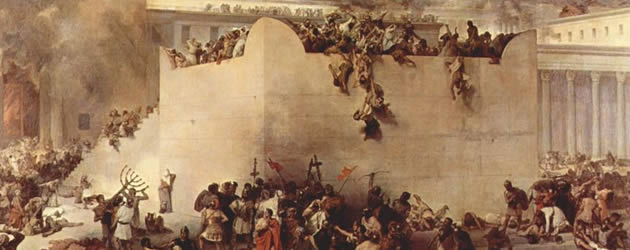
The Conquest and Exile of Israel and Judah Fulfill the Deuteronomic Curses
We come to understand how the Deuteronomic curses (outlined in the Book of Deuteronomy) are fulfilled in both the Northern and Southern Kingdoms as they break the Old Covenant by committing the grave sin of idolatry. First, the Northern Kingdom (10 Tribes) is besieged, conquered, and exiled by Assyria in 722 B.C. The people who once inhabited the Northern Kingdom eventually lost their national identity when Assyria intermixed them among the foreign nations in their exile among those nations. Simultaneously, we read in 2 Kings 17 how Assyria imported 5 foreign conquered peoples into where the Northern Kingdom used to exist (i.e. Samaria), and the Israelites who remained in the land interbred with these foreigners creating halfbreeds who practiced a hybrid form of religion consisting of Torah and pagan idolatry. These people in Jesus' day were known as Samaritans.
The Southern Kingdom (2 Tribes) experienced the destruction of Jerusalem, its walls, and Solomon's Temple under the reign of the Babylonian King Nebuchadnezzar in 586 B.C.. This Southern Kingdom is exiled to Babylon in three successive deportations. The Southern Kingdom only experienced exile in Babylon for around 70 years and were able to retain their national identity. When Medo-Persia conquered Babylon, the Persian King Cyrus decreed that the exiles could return to their homeland around 535 B.C.
This transcript was produced by speech-recognition software and has not been proofread. Names, Hebrew and Greek terms, and Scripture references may be misspelled. Tap a timestamp to play the audio from that point.
Who here has read parts of, other than just listening to it at church, who has read Ezekiel? Come on, all right, good. All right, six people. Okay, just giving you guys an estimate here. Okay, Ezekiel has a vision of four angels, and they're like beasts. You have a man, an ox, a lion, and an eagle. And in the early church, the early church would associate the four gospels with those four images. God bless you, sister.
And so, the early church associated Luke with the ox, Mark with the lion, Matthew with the man, and John with the eagle. And then these four creatures are shown again in Revelation. Revelation talks about them. Revelation is like a big pulls from all over the Old Testament, from Isaiah, from Jeremiah, Ezekiel, all over the place, especially Daniel. But I'm going to begin with some scripture here, and then we'll turn into our prayer. In the name of the Father, and of the Son, and of the Holy Spirit. Amen. In the center around the throne, there were four living creatures covered with eyes in front and in back.
The first creature resembled a lion. The second was like a calf. The third had a face like that of a human being, and the fourth looked like an eagle in flight. The four living creatures, each of them with six wings, were covered with eyes inside and out. Day and night, they do not stop exclaiming, Holy, holy, holy is the Lord God Almighty, who was, and who is, and who is to come. Whenever the living creatures give glory and honor in thanks to the one who sits on the throne, who lives forever and ever, the 24 elders fall down before the one who sits on the throne and worship him, who lives forever and ever. They throw down their crowns before the throne, exclaiming, Worthy are you, Lord our God, to receive glory and honor and power.
For you created all things. Because of your will, they came to be and were created. Father, we exclaim with thee, these four creatures, Holy, holy, holy are you. You are all holy. And this evening, we touch upon that holiness through the sacred page, which you have given to us, like the flesh of Christ, which allows for us to reach your divinity. We ask this evening for peace of heart. We ask for those gifts of the Spirit. That we received when we became Christians. That we would be empowered to understand your word. To have knowledge of it.
To be wise in it. To be given courage. That we may find counsel in it. That we may grow in a deeper piety and a filial fear before your throne. Lord Jesus Christ, be present now and let your Holy Spirit bow. All hearts and love and truth today to hear your word and keep your way. Give us the grace to grasp your word that we may do what we have heard. Instruct us through the scriptures, Lord, as we draw near, O God adored. To God the Father, and the Son, and the Holy Spirit, three in one. To you, O blessed Trinity, be praised throughout eternity.
Amen. Where was that in Revelation? Where was that in Revelation? Let me turn there real quick. I believe it was Revelation 5, but let me check again. It was in Revelation 4, starting in verse 6 and going to verse 11. The end of chapter 4 in Revelation. Yeah, the early church fathers, I believe it starts with, explicitly in Irenaeus, I think he associates Matthew with the human being, Luke with the calf, Mark with the lion, and St. John with the eagle. And there are different reasons for that. Luke focuses upon the sacrificial aspect of Christ. You have John soars above the rest with his lofty theological view, like the eagle.
Matthew is really concerned about the genealogy of Jesus, showing his humanity. Does anybody know why Mark is associated with the lion? I think it might have something to do with how it's, he keeps going so fast. He just keeps going. Mark is a very fast gospel. I forgot the exact reason why. This, I gave you guys this handout, and on the front, it gives the prophets of Israel and Judah. And so, all of these prophets, all of the prophets, the Nebiim, remember in Hebrew, prophets Nebiim, you have the Tanakh, the Torah, Nebiim, and Ketuvim. These prophets are pretty much all after 930 BC, when the kingdom divided into north and south.
When the northern ten tribes seceded from the southern two tribes of Judah and Benjamin. And so, we have all the prophets here. We have non-literary prophets, because they don't have books named after them, like Elijah and Elisha. And then we have literary prophets going from Obadiah to Malachi. And then we have the kings of Israel. Also, on the prophets, you can see whether they were pre-exile, before the exile, during the exile, or after the exile. It shows the audience to whom they proclaimed, the world power and power at the time. And in the biblical context, if you want to see about where were they preaching, you can look at that biblical context. Under the kings of Israel, these are all of the kings of the northern ten tribes.
The northern kingdom started out with its first king, Jeroboam I. Jeroboam was Solomon's servant. And so, Jeroboam took the ten tribes and seceded to the north. These are synonyms for the northern kingdom. And the northern kingdom's capital was in Samaria. And so, later on, this region is going to be known as Samaria. But back then, it was the capital city, Samaria. At first, Jeroboam had the capital in Shechem. But later on, it was moved to Samaria. And so, you have the different kings of the northern kingdom.
And when does Jeroboam start reigning? What year is it? 930 B.C. So, that's when the kingdom divides. It starts reigning at 930. When does the final Israelite king, Hosea, what's his final year of reign? 722. So, something significant is going to happen in 722 that's going to stop the reign of the northern kingdom. On the kings of Judah, when does Rehoboam start his reign? 930. The same time as Jeroboam, when the kingdom divides. Rehoboam is whose son? Solomon. Right. So, we have the Davidic kingdom. And the throne is going to be, is going to have, sitting upon it, the son of David. Or the grandson of David.
Or the great, great grandson of David. Or the great, you know, grandson of David. It's going to be a dynasty. Not just a kingdom, but a dynasty. And so, Rehoboam is going to be David's grandson. And you're going to continually have these relations going down through time. And if you look at the different kings of Judah, you'll see that there's a B or a G next to them. Whether they're bad or good. Not boy or girl. So, and we use M and F for that. The years reigned. How they were related to their predecessor. And notice that sometimes, like for instance, Jehoiakim was the brother of Jehoahaz. But he's still in that line of succession.
It's, that he doesn't, it's, he's not, he's the brother. But, but that also means that he is the son of Josiah. See? Because they were brothers. So they're still in the line. The line does not, is not messed up in any way. Even when you have Zedekiah, who's the uncle. Now, you'll see how they're, how they died in the scripture reference to them. Where they are in scripture. And so this will give you guys a better idea of exactly what's going on and who's reigning and whatnot. And if you're ever reading 1st and 2nd Kings, keep this close by. Because sometimes, kings in the north and kings in the south will have the same exact name. So different translations will translate them a little bit differently to try and separate them. And it gets really confusing.
So if you have this sheet of paper here, it'll really help you. And we'll talk about the back of the sheet of paper in a little bit. So in 930, the kingdom divides. And we have the northern kingdom. And what was the first thing Jeroboam did? What was his first royal action? Yeah, he set up golden calves in the southernmost point of the northern kingdom, Bethel. And in the northernmost point of the northern kingdom, Dan. And the author of the scripture gives to Jeroboam the same words that Aaron had. So these are your gods which brought you up out of Egypt. So we have a return to Egypt, a return to the idolatry. And what happens when you return to idolatry?
Not good things, right? Yeah, we've already found this out. Now remember, Deuteronomy gave blessings and curses to Israel. And Moses said, and both the blessings and the curses will be fulfilled in you. And all these things which I'm going to say to you today, all these curses will be fulfilled in you. Remember the curses? You had besiegement, famine, pestilence, captivity, exile. Remember Moses says that all this is going to happen. We'll find out that this happens to both the northern kingdom and the southern kingdom. But first to the kingdom of Israel, the northern kingdom. And this is going to happen in the year 722 BC. That's going to be like the definitive date.
But it starts, they start being conquered by a foreign power in 733. And this is important to note. And I'll show you why in just a moment. And the world power at the time in 733 BC was Assyria. And the Assyrians, they would absolutely, completely decimate foreign peoples when they would conquer them. I mean, it was horrendous. They were like a Hitler or Saddam Hussein. I mean, they would, it was absolutely, it was like watching a horror film whenever they would conquer people. And so you did not want to be attacked by the Assyrians. It was not a good thing. It was kind of like being a house and having carpenter ants. You know, watch out.
And so let's go ahead and open up our Bibles to 2 Kings. To 2 Kings chapter 17. 2 Kings chapter 17. And we're going to start in verse 1. 2 Kings chapter 17, verse 1. Okay, in the twelfth year of Ahaz, king of Judah. So which kingdom, north or south, is Ahaz the king over? South, right, Judah.
Hosea, son of Elah, began his nine-year reign over Israel in Samaria. So which kingdom is that? The northern, right. Here we go, the capital's in Samaria. And it's being called Israel here. He did evil in the sight of the Lord. Yet not to the extent of the kings of Israel before him. Shalmanesar, king of Assyria, advanced against him. And Hosea became his vassal and paid him tribute. Okay. But the king of Assyria found Hosea guilty of conspiracy for sending envoys to the king of Egypt at Saish. And for failure to pay the annual tribute to his Assyrian overlord. For this, the king of Assyria arrested and imprisoned Hosea. He then occupied the whole land and attacked Samaria, which he besieged for three years. Okay.
Now, what if, you know, the Brenham police, you know, surrounded your house for three years? And you dug up a well in your backyard because they cut off the water supply. They cut off the electricity. And you're there eating beans and rice. You're like, ooh, we got to eat those sweet potatoes that we've had in that can for so long. You know, we're going to give them to goodwill, but now we have to start eating them. And then it starts getting so bad that your children die of starvation. And you don't want to get outside of your house because the Brenham police, you don't want to know what they're going to do to you if you come out alive. So you start eating your children. This is what happened. This is what happened in the Old Testament. And this is also what happened to Jerusalem in 67 to 70 AD when the Romans besieged Jerusalem. The women started eating their own children who had already died.
That's right. It reminds you of a soccer team. The soccer team. What was that in the Himalayas or where was that? And so, and so, so this is not good. This is bad. This is very bad. We just, sometimes we just read scripture and it just goes over our head. But besieged for three years is a big deal. In the ninth year of Hosea, the king of Assyria took Samaria and deported the Israelites to Assyria, settling them in Hala at the Hebor, a river of Gozan. Wasn't Gozan, wasn't that name used in Ghostbusters too? I think that's where, or it was Gozar, I think. And in the cities of the Medes. This came about because the Israelites sinned against the Lord their God who had brought them up from the land of Egypt from under the dominion of Pharaoh, king of Egypt, and because they venerated other gods.
So we're told that the besieging, the destruction, and the exile due to the northern kingdom was because of why? Idolatry. Not just because it's just happened to happen, you know, in political history. But this is because of their idolatry. Deuteronomy is being fulfilled. And so these people in the northern kingdom, these northern ten tribes, they start being attacked in 733 B.C. In 733 B.C. And this, and it was made a tributary, we're told. And the conquest actually began in the northernmost region of the northern kingdom. Okay, let's say, let me use the blue marker here. Here's the Sea of Galilee. Here's the Jordan River.
Here's the Dead Sea. And the, this northernmost part of the kingdom up here is Zebulun and Naphtali. Zebulun and Naphtali are the, are the tribal lands. Not in that order, I don't believe. I think Naphtali is over to the left and Zebulun is to the right. But in any case, that's where they started being attacked. It was right there. And it was, I mean, and it was, you know, Assyria again. This is, this is not just, you know, some foreign empire. This is the worst. And so, uh, we see in 733, they start being attacked. 722, we have this exile. Where are they exiled to? What does the text tell us? To Assyria. Okay, so we have like the Assyrian exile of how many tribes? 10.
Now, a lot of people were left in the land, especially a lot from Zebulun and Naphtali. But people from, from all, uh, 10 tribes were being exiled. Okay, let's do this. Let's open, let's keep our finger here in 2nd Kings 17. And let's turn to the Gospel of Matthew, the first Gospel. By the way, I want to correct an error that I, that I, uh, I proposed in a previous Bible study. I told you that the, uh, Gospel of Matthew was written in Hebrew. Uh, and then, and then it was later translated to Greek. Uh, uh, this is, again, as further proof, I am not infallible. It was written in Aramaic. This is what the, the earliest historians of the church say is that, uh, Matthew was written in Aramaic. Uh, and then it was translated into Greek because Aramaic was what, I mean, Jesus spoke.
It's what the people around Palestine, uh, well, Palestine is also an, an anachronism, uh, because it wasn't called Palestine back then. It was just called the land, um, or the Holy Land. But let's turn to Matthew chapter 3. By the way, I wonder if in Matthew's Gospel it ever says, you know, in Jesus, use these words, and then it translates it for you. You know, because, I guess if he's writing a thing in Aramaic, he would never have to do any translating, right? Okay, let's turn to Matthew 3, and let's look at verse 12. Jesus has, uh, just, uh, been baptized, and he had his, uh, temptation in the desert. And in verse 12, we read, When he heard that John had been arrested, he withdrew to Galilee.
He left Nazareth and went to live in Capernaum-by-the-Sea in the region of Zebulun and, oh, I'm sorry, I'm in chapter 4. Oh, you guys don't, oh, the ESP must not be on in here. You guys, that's right, I, I did tell you that. I'm just trying to see if you guys are awake, that's all. You know, yeah, that's right, this is a, I meant that all along. This is a test. Beep. This is in chapter 4, verse 12. Yes. Redo. Take two. When he had heard that John had been arrested, he withdrew to Galilee. He left Nazareth and went to live in Capernaum-by-the-Sea in the region of Zebulun and Naphtali. That what had been said through Isaiah the prophet might be fulfilled.
Land of Zebulun and land of Naphtali, the way to the sea beyond the Jordan, Galilee of the Gentiles. The people who sit in darkness have seen a great light. On those dwelling in a land overshadowed by death, light has arisen. That's Isaiah 9, verses 1 through 2. Isaiah is talking about where Assyria started the conquest of the land. And Isaiah says, hey guys, Zebulun and Naphtali, the Assyrians came, you know, this is a time of darkness. Well, you will see a great light. Something is to come. A light will arise. You people who sit in darkness, you will see a great light. And so Matthew says, now that light is here. And notice that Jesus starts his ministry where the exile began.
Again, Jesus is coming to put Humpty Dumpty back together again. Remember, Rehoboam said that he was going to, you know, tighten and, you know, make the yoke of his father even heavier. And Jesus says, you know, my yoke is light, my burden is, you know, is easy. And so, you know, rest. You know, Jesus is saying, look, I'm going to undo what Rehoboam did. I'm going to undo what Assyria did. I'm undoing the exile. I'm the Messiah. And next week, we're going to talk more about these prophecies. We're going to turn more next week to, like, Jeremiah and Hosea and some other prophets. And we're going to look at how this is, we're going to shed some, even some more light on this. But this is very important that when Matthew is writing his gospel, he expects for you to go, oh, yeah, that's where Assyria started attacking them. Huh.
Yeah, that's why Isaiah, well, actually, they didn't have a chapter back then. The Catholic Archbishop of Canterbury put chapters, Stephen Langton put chapters in the Bible. So they didn't say Isaiah 9. They said, oh, the beginning of Isaiah. Yeah. Okay. In 722, we had the final capture. And who was the final king of Israel? Hosea. Now, let's read more about this exile. Let's turn to 2 Kings 17. I promise you it's chapter 17. And we're going to start in 2 Kings 17, verse 24. 2 Kings 17, verse 24.
I see somebody without Bible tabs. Somebody give this guy five bucks. All right. The king of Assyria brought people from Babylon. Count them with me. Babylon 1, Kuthah, 2, Ava, 3, Hamath, 4, Sefervaim, 5. So how many foreign peoples were brought by the king of Assyria? Five. Let's keep that in your mind. Okay. Keep that back there in that part of your memory. It's like your RAM, your random access memory. Okay.
And he settled them in the cities of Samaria in place of the Israelites. They took possession of Samaria and dwelt in its cities. When they first settled there, they did not venerate the Lord. So he sent lions among them that killed some of their number. A report reached the king of Assyria. The nations whom you deported and settled in the cities of Samaria do not know how to worship the God of the land. And he has sent lions among them that are killing them since they do not know how to worship the God of the land. Okay. They think that Yahweh is like some local deity. You know, you don't appease a deity, you know, and he's going to send lions off to you. So appease a local deity, you know. Send one of the priests back. Send one of the Israelites back who knows about Yahweh so they can appease this local deity. This is what the king of Assyria thinks. Verse 28.
So one of the priests who had been deported from Samaria returned and settled in Bethel and taught them how to venerate the Lord. But these peoples began to make their own gods in the various cities in which they were living. In the shrines, on the high places which the Samarians had made, each people set up gods. This is the first time in scripture the word Samarian is used. Okay. These are who the Samarians are. Thus, the Babylonians made Marduk and his consort. The men of Kuth made Nurgal. I'm sorry. The men of Ava made Nebhaz and Tartak. And the men of Sepharvim immolated their children by fire, their city gods, King Hadad and his consort Anath.
Sounds nice. Don't let your kids read this. They also venerated the Lord, choosing from among their number priests for the high places, who officiated for them in the shrines on the high places. But while venerating the Lord, they served their own gods, following the worship of the nations from among whom they had been deported. To this day, they worship according to their ancient rites. So the Samarians in the time of Jesus are half-breeds. They're like hybrids between Israelites who were left in the land and the people who had been, who were foreign conquered people, among whom were the Babylonians. The Babylonians at this time were not the world power Assyria was. So you have these five people were imported into Samaria and were interbred.
And this is the way that Assyria decimated foreign peoples and got rid of them. They made them, worse than genocide, this is kind of like cultural side. This is religion side. This is getting rid of your ethnicity, ethnicity side. It's doing away with your national identity. To where the people can't rally around the Israelite flag anymore because they've forgotten who they are. And so there is no such thing as a return from exile from these people who went off to Assyria. They were intermixed with other foreign peoples. And foreign peoples that Assyria had conquered were brought into the land to intermarry among the Israelites who were left. And so the Israelites are kind of like people who practice voodoo in Haiti, Haitian voodoo. You know, it's an African religion, a pagan religion, voodoo.
And they kind of mix it with Catholicism. So you'll have people there making the sign of the cross, wearing crucifixes. But they're practicing voodoo. It's really bad. Watch out. In fact, the people in the military, I was told by one of our Franciscan friars up at the Franciscan University of Steubenville. He used to be in the military before he became a priest. And he was telling us about how in the military they were commanded not to touch anybody who practiced voodoo. Like whenever they went into Haiti, not to touch anybody because guess what? Bad things happen when you touch one of them. You contract some of this evilness that, you know. I've never read The Rainbow and the Serpent. It's exactly, it's about what you're talking about. It's about what I'm talking about. Okay, good. The Rainbow and the Serpent. The Rainbow and the Serpent about how they mix Catholicism with their own. Okay, good.
Okay, I have no clue. Okay, but these are books that talk about this merging of two religions, of voodoo and Catholicism. And this is what's happening in Samaria. And so in Jesus' day, the Jews in Judah hated Samarians. Because the Samarians were, I mean, they were like pagans. It's like they thought that they knew what true religion was, but they were still worshipping all these foreign idols. And so the Samarians were absolutely hated. And I'm sorry, how many foreign nations were brought in? Five.
Five, okay, okay, just checking. Okay, so also here's another cool thing to know is that the Samarians only accepted the Torah. They did not accept the prophets and the writings. By the way, Jews even to this day consider Joshua, 1 and 2 Samuel, 1 and 2 Kings, to be among the prophets. So, and today we just separate them differently. Instead of calling them prophets, we call them the writings. And so when Jesus says, he talks about the prophets, he talks about the law and the prophets, he's including the books that we think of as the historical books. He's not leaving out the historical books. Yes? I'm sorry, I need to clear up something before we go on. Sure, sure. I think I misunderstood something. Now, the Israelites were already there in the Samarian area. I thought they were sent there after they were conquered.
I thought they were sent there to intermix with these other people. No, the Israelites had always been there. Okay. And these other people were from, if we look in 17, verse 24, he brought people from Babylon, Kutha, Ava, Hamath, and Sephirvim. And so Babylon, you know, is... I was just remembering what it said in here, and I just misunderstood. Okay, that's fine. That's fine. Good. Well, it's better to ask a question than be sitting there going, oh my gosh, what is he talking about? This is nuts. And so, which I'm sure all of you are doing, but she got her confusion taken care of. Okay, let's go ahead and, you know, let's turn to John chapter 4, the fourth gospel of John. And we're going to see a little bit of the eagle in John. We're going to see a little bit of why the early church fathers associated John with the eagle of Ezekiel's vision. John chapter 4.
So it says that Jesus had to pass... I'm going to wait for you guys just a little bit longer. I'm going to be merciful. I'm full of mercy and kindness. Slow to anger. Okay, here we go. Okay, here we go. Verse 4, chapter 4 of John's gospel. He had to pass through Samaria. Okay, because Jesus is down here in Galilee. Let me go ahead and draw you a little map here. We have... I'm sorry. Down here in Galilee. Galilee's way up here in the north in Jesus' time. Samaria's right in the middle. And then Judah is down at the bottom. And so, Jesus is down here. He's in Judah. And he needs to get back up to Galilee. And what Jews would do is they would actually go over here through Perea to the east of the Jordan. And then they would...
To get around Samaria. And then they would go up into Galilee. But Jesus, you know, Jesus has guts. He practices that Isaiahan virtue of courage. And he goes right up through Samaria. He said, you know, I have to go through Samaria, so I'm going to go. And so, this is what we read. John chapter 4, verse 5. So, he came to a town of Samaria called Sychar, near the plot of land that Jacob had given to his son, Joseph. Jacob's well was there. This is very important. The gospel author spares no words. Okay? Jacob's well. Jesus, tired from his journey, sat down there at the well. It was about noon.
A woman of Samaria came to draw water. Jesus said to her, give me a drink. His disciples had gone into the town to buy food. The Samaritan woman said to him, how can you, a Jew, ask me, a Samaritan woman, for a drink? And then we're told, for Jews use nothing in common with Samarians, or Samaritans. Jesus answered and said to her, if you knew the gift of God, and who is saying to you, give me a drink? You would have asked him, and he would have given you zoe water. Or zao water. And this Greek word can mean either two things. It can mean either flowing or living. Jesus means living, living water, you know, the Holy Spirit.
She's thinking of, like, flowing water. You know, she's looking for this flowing water. I mean, she has to go all this way, and go to a well, and dig down, and get it. She's like, man, I want some of this flowing water, right? The woman said to him, sir, you do not even have a bucket. And the cistern is deep. Where then can you get this living water? Are you greater than our father Jacob, who gave us this cistern and drank from it himself with his children and his flocks? Now, when she says, you know, living water, she says, where then can you get this living water? The authors of my Bible, the New American Bible, translate it as living. But she really means flowing. It's the translators of my wonderful Bible that I love so much.
You know, I thought they knew what she meant. So, of course, I think I know what she meant, too. So, we'll have to battle it out in heaven. Verse 13, Jesus answered and said to her, everyone who drinks this water will be thirsty again. But whoever drinks the water I shall give will never thirst. The water I shall give will become in him a spring of water welling up to eternal life. The woman said to him, sir, give me this water so that I may not be thirsty or have to keep coming here to draw water. She still doesn't get it. It's the same thing. Notice that this is John chapter 4. What happened in John chapter 3? Nicodemus comes to Jesus and Jesus says, one must be born onothin. Onothin can either mean from above or again. Jesus means one must be born of water in the spirit.
One must be born onothin. One must be born from above, from the spirit, through water. Baptism. Is it said, you know, right before that, Jesus is baptized. At the end, it talks about Jesus baptizing his disciples. That's called an inclusio. John gives the theme before and after he talks about it. Nicodemus thinks that onothin means again. So he's like, how could a man be born again of the womb? You know, how can he reenter his mother's womb and come out again? And Jesus is like, oh. You know? Well, he's doing the same thing with the Samaritan woman. And so Jesus says in verse 16, go, call your husband and come back. The woman answered and said to him, I do not have a husband. Jesus answered her, you are right in saying, I do not have a husband. For you have had five husbands.
And the one you have now is not your husband. What you have said is true. The woman said to him, sir, I can see that you are a prophet. Okay, for Samaritans, the prophet was the great Tahib, the coming one. From the end of Deuteronomy. Remember, they only had five books of the Bible. Genesis, Exodus, Leviticus, Numbers, and Deuteronomy. And towards the end of Deuteronomy, Deuteronomy 18, we have Moses saying that there will be a prophet who will come like unto him. And so the Samaritans didn't so much have the, they weren't so much looking forward to the Messiah. They were looking forward to the great prophet to come. And so she's like, you're the prophet. Well, what happened at, you know, we're told that this happened at Jacob's well.
Guess who met his wife at a well? Jacob. Guess who, where Isaac, Isaac met his wife? A well. Guess where Moses met Zipporah? A well. A well is kind of like the place to hook up in the Old Testament. Okay? Now, let's turn to John chapter 3, John 3, and let's look at verse 29. John 3, 29. John the Baptist says, the one who has the bride is the bridegroom. The best man who stands and listens for him rejoices greatly at the bridegroom's voice. So this joy of mine has been made complete.
He must increase, I must decrease. Who does John the Baptist say is the bridegroom? Jesus. And then Jesus says, the one who you have with you now is not your husband. But you have had five husbands. Samaritan woman. Remember, John's basing his gospel off of Genesis. He begins by kind of paralleling Genesis 1. In the beginning was the Word, and the Word was with God. And the Word was God. And there was light and darkness, you know, and the light overcame the darkness. And then, you know, he goes through. And then just as in Genesis 2, you had a marriage, what happens at John chapter 2? The wedding at Cana. And only two people are mentioned, or named, I mean. Mary and Jesus. And what does Jesus call Mary?
Woman. You had Adam, and you had the woman because she came from man, we're told in Genesis 2. So John is showing us, by the way, the prophets would talk about the new covenant as God re-espousing himself to his people, like a bridegroom. And here we have John showing Jesus as the bridegroom. And Jesus is saying, okay, these five husbands, these five foreign peoples that you've brought their gods with them, and they've intermarried with you guys, and now you all are worshiping these gods of these five peoples. Well, I want to take you away from that, and I want to forgive you of your sin and your idolatry, and espouse you to myself. Kind of cool, huh?
Yeah. I'm not making this up, by the way. Okay. Let's turn back and let's look at some more. Let's look at these people with the exile. We had this exile, and we had the five people came in, and they intermarried among the Israelites. And so the Israelites kind of lost their national identity. And these ten tribes who were here in the northern kingdom, they were exiled off to Assyria, never to be heard of again, because they were intermixed among the Gentiles, the ethne, the Gentiles, the nations. And so you no longer have these ten tribes out there. I mean, some people say, you know, they became, you know, the Vikings, or maybe they became the Africans, or maybe they went up and intermarried among the Russians, you know.
Where did they go? Nobody knows. There's so many different theories. You know why. You can't find them, because they're hiding. We just have yet to find them. No, it's because they were, they did the same thing that happened in Israel, in the northern kingdom. It happened elsewhere. These Israelites lost their identity. They became, like, it was like a melting pot. They kind of lost their ethnicity. Do we have any mutts in here? Do we have any, there we go, Augie back there. Augie, what ethnicity are you? No, then you're not a mutt, if you know you're German and Irish. No, you know, you kind of, after a while, you know, in the melting pot, you lose your identity. You're no, you no longer say, I am a, you know, a Jew, a Judahite. I ain't no, no, I know, I'm a Benjaminite. You know, they don't know.
You know, they're like, I'm an Italian. You know, and then later on, you know, we say, we're Italian. But the Italians probably were a mix, you know. But, so this, we have this deportation, and after 722, the northern kingdom is now becoming Samaria. And we have this hybrid religion. What about the southern kingdom? Southern kingdom continues. And it's doing quite well. But let's turn to 2 Kings. Instead of chapter 17, let's turn a little bit later to chapter 21. 2 Kings chapter 21. You said something earlier about one of the New Testament to find out why one of those mastermarked with John was a lion. What was that?
Oh, I said I didn't know. Yeah. Thank you for pointing out my ignorance. So, the woman, the Sumerian woman, actually acknowledged her heritage, however, when she said this is Jacob's well. Well, Jacob's in the Torah, so you know her heritage. I mean, but since she was in her mix, so they had some of their heritage left. Is that what you mean? Right, right, the Samaritans, they still consider themselves, you know, part of the people. And they are. But the people who were exiled to foreign lands, they didn't know who they were. They lost their identity.
The Samaritans, even though they were intermarried, they still considered themselves Jews. Right. In the same way that some voodoo people consider themselves to be Catholic. Okay. Poor Samarians. Yeah, poor Samarians. That's right, and that's what the Jews would say, too. Okay, 2 Kings chapter 21, verse 1. Manasseh was 12 years old when he began to reign, and he reigned 55 years in Jerusalem. His mother's name was Hephzibah. By the way, there you go again. The queen mother is mentioned. He did evil in the sight of the Lord, following the abominable practices of the nations whom the Lord had cleared out of the way of the Israelites. He rebuilt the high places which his father Hezekiah had destroyed. He erected altars to Baal, and also set up a sacred pole, as Ahab, the king of Israel, had done.
He worshipped and served the whole host of heaven. He built altars in the temple of the Lord, about which the Lord had said, I will establish my name in Jerusalem. Altars for the whole host of heaven, in the two courts of the temple. He immolated his son by fire. A great dad, right? He practiced soothsaying and divination, and reintroduced the consulting of ghosts and spirits. He did much evil in the Lord's sight, and provoked him to anger. Hmm, not a good thing, right? So Manasseh is not exactly the model king. Okay, I'm going to keep reading here. I'm going to start off with verse 10. Then the Lord spoke through his servants, the prophets. Because Manasseh, the king of Judah, has practiced these abominations, and has done greater evil than all that was done by the Amorites before him, and has led Judah into sin by his idols, therefore, thus says the Lord, the God of Israel, I will bring such evil on Jerusalem and Judah,
that whenever anyone hears of it, his ears shall ring. I will measure Jerusalem with the same cord as I did Samaria. Uh-oh. Not good. And with the plummet I used for the house of Ahab. I will wipe Jerusalem clean as one wipes a dish, wiping it inside and out. I will cast off the survivors of my inheritance and deliver them into enemy hands to become a prey and a booty for all their enemies, because they have done evil in my sight and provoked me from the day their fathers came forth from Egypt until today. Ouch. So now, because of the idolatry of the southern kingdom, God says, okay, it's your turn.
The northern kingdom, you know, you look at them as being all idolatrous and stuff. Well, now your king and all of you people, you've fallen into this idolatry. So, Deuteronomy is going to be fulfilled not only in the northern kingdom, but also in the southern kingdom. Now, notice that, let's see when Manasseh reigned. Manasseh reigned from 697 to 642. Well, later on in 625 B.C., Babylon became the ruling world power. So, we're not going to have the Assyrian exile, we're going to have the Babylonian exile, because now Babylonian is the big cookie. And so, in 625 B.C., Babylon basically comes to reign, and we'll find out that, under the Babylonian king, Nebuchadnezzar, great name, Nebuchadnezzar, gosh, that would, I hope he didn't have telemarketers calling him all the time.
Is Nebuchadnezzar at home? You must be a telemarketer. You don't know how to say his name. And so, Nebuchadnezzar was king, and we actually have, we have three deportations, three successive deportations of Judah. The first one occurs in 605 B.C. Okay, so we have the first deportation of people to Babylon in 605 B.C. among whom is Daniel, the prophet. Daniel is sent in this first deportation. The second deportation occurs in 597 B.C. And that includes Ezekiel. And then the third deportation occurs when Jerusalem itself is destroyed, as well as the temple, the plate is wiped inside and out, quite literally, 586 B.C.
And that's the end. I mean, it was considered the end of the world to the Jews. It was, I mean, we would consider it the end of the world if New York City and Washington, D.C. were both wiped off the face of the earth, wouldn't we? We'd go, where's our national identity? You know? And so, we have these three successive deportations, and when does it start? 605 B.C. And we'll also see that in 550 B.C., let's see here, in 550 B.C., Babylon will be conquered by the Medo-Persians, the Medes and the Persians. So, it's called the Medo-Persian kingdom. In 550 B.C.
And then, in 5, bleh, that's not a five, that's a six. In 535 B.C., the Medo-Persian king, Cyrus, comes to power, and Cyrus gives a decree for the people to return to the land, in 535 B.C. So, the Judahites, the Jews, the Judahites, the Benjaminites, and who also was among them? What other tribe? The Levites. The Levites never got land. The Levites were in the Levitical cities in both the north and the south. So, what tribe is John the Baptist from? Levi.
Because his father served in the temple, so we know he was a Levite. What tribe was Jesus from? Judah. What tribe was Paul from? Benjamin. Right. So, so these are the three tribes that are in the south. Well, they're only in exile for a little while. And the prophets in exile prophesy about how they're going to return to the land, and the Messiah will come. The Messiah, the king, will come to reign. And by the way, how much time passes between the first deportation in 605 B.C. and this decree in 535 B.C.? Seventy years. And so, Jeremiah the prophet tells us that 70 years of exile are decreed for the Jews, the Judahites, the Benjaminites, and the Levites.
And from, and when they return to the land under Ezra and Nehemiah, you know, Ezra the priest and scribe and Nehemiah the layman, this is the first time that the term Jew is used in the scriptures. I forgot which book it's in. I think it's, might be in Ezra. I'll, I'll point it out probably next time. And so the Jews now are composed of Judahites, Benjaminites, and Levites. They all kind of call themselves Jews. But they still recognize their tribal identity. So Paul in Romans 9 will still say he's a Benjaminite, even though he considers himself a Jew. Yes. So the northern kingdom had 10 tribes? Yes. Why are there 3 to 13? Because the Levites were in all the, were in the north and the south.
The Levites didn't have tribal land. That's a great, that's a great question. Okay. So who was the final Davidic king? Who was the final king of Judah? Zedekiah. No, it wasn't. It was Jesus. It's a trick question. Huh? Well, he's not on your list. He's not on my list. I leave that, it's fill in the blank. That's what that is. Right. Always remember, Jesus came, Jesus is the successor of Zedekiah to the throne. So when Jesus is the king, and we have the kingdom of heaven, this isn't some nebulous, oh, where's the kingdom of, you know, it's just God rules, you know, God's king. No, it's the Davidic kingdom. Jesus came as the son of David, the son of Zedekiah, the son of Jehoiakim, the son of Jehoahaz, the son of Josiah, the son of Ammon, the son of Manasseh, the son of Hezekiah, the son of Jehoiakim.
Yeah. Yes. In the New Testament, over and over again, I got the impression or read somewhere that the Jews are trying to make him king, and he didn't want to be king, because he wasn't the wrong kind of king. Right. Because the kingdom that they were looking for was political and military. Like, Jesus would sit upon an earthly throne, and, you know, he would command his legions, you know, but Jesus, what we find out in the exile, is that, is that God trains, the people in the exile, to reign through suffering. Like, a kind of like priestly suffering, is the way that they reign. And in Jesus, this is fulfilled. Jesus is both king, and he reigns through his suffering, and by his selfless sacrifice.
And his reign is primarily in heaven. It's going to be a heavenly reign. The kingdom of heaven. But yet, this kingdom, we're told, is on earth. Jesus says to his contemporaries, the kingdom of God is among you. The kingdom of God is at hand. He says, you know, he talks about the coming of the kingdom. He says, this generation will not pass away, until all these things take place. And the book of Revelation, talks about the destruction of Jerusalem, in apocalyptic, allegorical terms. And the book of Revelation is all talking about the coming of the kingdom in the form of the church, and the destruction of Jerusalem in the temple. And there's no longer a need for temple sacrifice. There's no longer a need for having to flock to Jerusalem, because the heavenly Jerusalem has now been established. That heaven has come to earth.
And so the early church saw their worship, not as an image of heaven, but as a participation. This is a major theme in the book of Hebrews, is that we no longer worship with a copy of heavenly things, but now there's the reality. We don't just, you know, our high priest has entered the Holy of Holies, the heavenly Jerusalem. And the author to the epistle to Hebrews talks about how you have come to Mount Zion, to myriads of angels. And so, and he's using this imagery of how the Christians are actually in the kingdom when they're still on earth. It's a very realistic type of language that's being used. Yes, yes.
That's what they were hoping. Yes, they were hoping for someone who would conquer the Romans. And this is why when Jesus was crucified, it looked like a failed Messiah. Because the Messiah is supposed to conquer the Romans. Not the Romans conquer the Messiah. What's going on? But then Jesus conquers death and sin, our real enemies, through the resurrection. And then Christians follow him. We start having everybody's martyred. The first 30 or so popes in the early church were all martyred for the faith. That's not a good track record, you know, if your kingdom is earthly. It's like, what are you dying for? You know, you're supposed to stay alive. If this is an earthly kingdom, uh-uh. They're reigning through their suffering. And this is what Jesus shows us. He says, come follow me, take up your cross. And Jesus is crowned with the crown of thorns.
And the book of John, I think I've told you before, biblical scholars divide it into the book of signs and the book of glory. Actually, from your perspective, the book of signs and then the book of glory. Because John talks about Jesus' crucifixion as his glorification. Jesus says at the Last Supper, Father, glorify me as I have glorified you. Now, the hour for the Son of Man, you know, has come. Now is my hour when the Son of Man is going, you know, to be glorified. What are you talking about? You're being crucified. But John shows the crucifixion as an enthronement upon the throne of the cross. Jesus is ultimately reigning in his suffering. This is the way that he's going to reign. And so the early Christians gained thousands of converts not by force, but by priestly suffering and praying and witnessing.
This is how pagan Rome was overcome eventually. Let's see here. Rome was eventually overcome in the year 476. And this is how the known world was Christianized. By the way, there's a really good book out by Rodney Stark. And it's called The Rise of Christianity. Do you guys ever want to know how the early church got to be so big and all of a sudden the Christians are everywhere? There's this myth that the church was really small until Constantine. Constantine made it legal. Then all of a sudden the church just explodes. But Rodney Stark, who's, I don't even know if he's Christian, but he writes in The Rise of Christianity, I believe he's a professor in Oregon.
He's a sociologist and he shows how the Christianity was exponentially increasing little by little and he shows how it increased and he uses real historical sources to show. And he talks about how when diseases and pestilence would come upon a city, the Christians wouldn't leave, they wouldn't fear suffering, they would embrace suffering and they would face it and they would take care of their neighbors. Well, guess what happened when the disease was over with? Their neighbors would go, I like you. You kept me alive. What's this? Why did you stay here when everybody else fleed? And then the Romans are killing all their girls. In fact, they talk about how there was so much infanticide, so many infants were flushed down the toilet that whole sewers were clogged. Yeah. And how there was a disproportion in sex like there is today in China.
There were too many men for the women. But among the Christians, the Christians respected women. Women were given a status that they didn't have anywhere else in the pagan empires. And so women, you know, could reproduce, but, you know, Roman women, there's not as many, or, you know, throughout the Roman Empire. So, and also, by the way, guess what helped cause the fall of pagan Rome? The fall of the family. And this is why when we see homosexual marriage being condoned, and we see, you know, the divorce rate at 50%. I mean, guys, this isn't just about our personal freedom. This is sociological. This is economical. This is about the very existence of our society.
So, we're going to find out that our own freedom in divorce and remarriage and our own freedom and, you know, whether or not I can get married to someone of my own sex because I want that freedom, our personal freedom is going to kill our society just like it happened to Rome if we don't turn around. And this, you don't even need religion to figure this one out. This is sociological. This is how God set up society. So, who thinks that we can just turn around on him? Now, Zedekiah, the next to last Davidic king, not the last, he was blinded, bound, and exiled to Babylon. And so, from 586 until the ascension of Jesus Christ to the right hand of the Father upon the throne of God in heaven, there's no Davidic king sitting on the throne.
But the throne still exists. There will be a successor, as we're told in 2 Samuel 7. You know, the throne will endure forever. Six centuries of no king on the throne. Could you imagine? six centuries without having a president of the United States? Without having a congress? Well, actually, they did kind of have a congress. They had the Sanhedrin. And the Pharisees sat on Moses' seat, which was a position of authority, which is what the early, which is what the Jews believed. Jesus says to his disciples, he says, do as the Pharisees say, because they sit on Moses' seat, but do not do as they do because they're hypocrites. And by the way, Moses' seat, nowhere in the Old Testament.
It comes from Jewish tradition because the Jews had an oral tradition that was just as authoritative as the scriptures. So Jesus could say, sit on Moses' seat. Well, the Jews would go, it's nowhere in the Bible. Where? Where's Moses' seat? No, it was there. This is what Jews believed. This is what they practiced. And the early church fathers, guess what they called, guess what they said what happened with Peter. They said that Moses' seat gave way to Peter's seat. That's right. And by the way, if you still go to the synagogue, I believe it's upping, I forgot where it is, but there's still Moses' seat. It's still there. It's still, I mean, like the symbol of it. It's still in an old synagogue that's been torn down. It doesn't have a roof any longer, but it's still sitting there. And the tour guides will still point to it and they'll say, that's Moses' seat right there. Of course, this is a symbol,
but nonetheless. And in the book of Daniel, we're just going to look at it very briefly. The book of Daniel was written during the exile. If we look at our prophets here, we have Daniel in the exile. And Nebuchadnezzar has three dreams. He has one in chapter two, one in chapter seven, and one in chapter nine. The king dreams. And he needs an interpreter for the dream. What does this remind you of? Joseph and Pharaoh. Pharaoh had dreams, or a dream specifically, and Joseph became the interpreter of dreams. And so these dreams correspond to one another. They're not completely different things.
There are three dreams that talk about the same thing. The first dream is about a statue with a head of gold, with a breast and arms of silver, thighs of bronze, legs of iron, and feet of iron and clay. And then he dreams of a mountain and a stone that's hewn from the mountain without human hands. And then the stone strikes the feet of the statue and causes it to crumble. And then the stone becomes a mountain and fills the whole world. And what Daniel is talking about here are the kingdoms. He's talking about the four world powers before the kingdom of God. And if you notice here on this handout I gave you, I quote this verse from Daniel 2, 34 to 35.
When Daniel is interpreting the dream and he says, a stone which was hewn from a mountain without a hand being put to it struck its iron and tile feet, breaking them in pieces. The stone that struck the statue became a great mountain and filled the whole earth. Well, if you, don't do it now, but if you turn to Luke 20, verse 18, Jesus applies that Danielic prophecy to himself. Jesus says, this kingdom that's going to come after these four major kingdoms, I'm the guy, I'm the stone, I'm the one who's breaking these kingdoms, I'm the Danielic kingdom. And we find out that Jesus calls himself the son of man, this is a Danielic term that comes from chapter 7 of Daniel.
Let's look at that, hold on just a second, let's look at it real close, real quickly. In Daniel chapter 7, we have the dream about the four beasts who represent the same four empires, and a conservative traditional interpretation of these four empires are that the gold head and the lion with wings, the lion with wings is in the dream in chapter 7, they represent Babylon. The silver chest and the silver arms and the bear with three tusks represents Medo-Persia. The bronze thighs and the four-headed leopard with the four wings symbolizes Greece. Alexander the Great conquered the whole known world by the time of his early 30s. I mean, he conquered it like that, like zoom, you know?
And so, what is a leopard with wings? I mean, that's like, you know, woo fast! Like, you know, we're talking about a jet rocket, you know, I mean, good grief, watch out. And so, you know, that can resemble Greece. And then the most horrendous beast, and I give you kind of a funny picture here that's supposed to be the most horrendous beast, is supposed to, you know, it's kind of like the iron legs and the iron with clay and that's Rome. And so, who was the world power reigning when Jesus came in? Rome, right. And Pontius Pilate was kind of like a local guy for Caesar. Caesar kind of appointed him there, kind of like our bishop appoints our pastor over our church. You know, he's kind of like the local guy. And so, we have, we have these four world kingdoms.
Now, some people will put Babylon as the first, the Medes as the second, the Persians as the third, and Greece as the fourth. That's a, that's a more, that's a kind of a more liberal interpretation. And that, that could, that could be the case. But I'm just giving you one out of several interpretations here. And this is, I believe this is the one that St. Jerome held to when he was teaching. If you see, if you see me, I'll, I generally like to opt for what the early Christians believed more than what, you know, biblical scholars speculate about. That's just kind of one of my preferences. And so, but in Daniel chapter seven, right after the second dream that Nebuchadnezzar has, Daniel has a vision.
And we're going to, this is going to be read from in, actually, Jesus is going to quote from Daniel seven in this Sunday's gospel. If I can find Daniel. There we go. Daniel chapter seven, verse 13. As the visions during the night continued, I saw one like a son of man coming on the clouds of heaven. When he reached the anoint, the ancient one and was presented before him, he received dominion, glory, and kingship. Nations and peoples of every language serve him. His dominion is an everlasting dominion that shall not be taken away. His kingship shall not be destroyed.
And again, Daniel's talking about this kingdom that's going to come, this stone, you know, that's going to, that's going to be hewn from a mountain without human hands. So it's going to be a divine, you know, intervention. It's going to be something that happens without human, the stone is not, it's not going to come about by natural means. And so we have the virgin birth of Jesus, you know, and Jesus is divine. But Jesus calls himself the son of man. He's not just saying, he's not just saying, oh, you know, poor me, I'm just the son of man. You know, I'm not the son of God, I'm the son of man. No, the son of man means that he's going to be the king. The everlasting king is going to be presented before the ancient of days, God the father. And so when Jesus says that he's the son of man, the Pharisees and the scribes, you know, they rip their garments and they're like, blasphemy.
You know, if we didn't know Daniel, we'd be like, what, he just said he was the son of man. What's wrong? But notice it says, one like a son of man coming on the clouds. And where is he coming to? Is he coming to earth? No, he's coming to God, to the ancient one. And so Jesus in the Sunday's gospel talks about all these things. False messiahs, false prophets, tribulations. And then he says, he says, and then you will see one like the son of man coming on the clouds. And then he says, and all this shall take place in this generation. And the generation was how many years to the Jews? 40. Jesus lived and died about what years?
30 through 33. He had 40 years to that. Jewish-Roman war. Destruction of Jerusalem. In fact, what's happening when Jesus says this is he's looking, he's at the Mount of Olives and he's looking at the temple when he's saying this. If you look at the context. And he's talking about the temple being destroyed. And all these things, and Josephus, the early Jewish historian, tells us about the false messiahs and the signs in the sky and all this stuff. In fact, he talks about this miraculous, they kind of saw like chariots being driven in the sky before the destruction of Jerusalem. These signs in the sky. Guess what? Guess who was not caught in the destruction of Jerusalem? Guess what people? The Christians. Because Jesus warned them to flee to the hills in Perea, east of the Jordan.
Christians didn't, Christians believe the word of their Messiah. And they escaped Jerusalem when they saw those signs. When the fig tree started to change color, started to change, they knew that it was about to produce its fruit. They followed Jesus' admonition and his parable about the fig tree. And so, often people are thinking, oh, well, this is talking about the end of the world. When Jesus is going to come back, he's going to be like, yee-haw! And he's going to be riding on the clouds and he's going to come to earth. He's going to be like, come on, guys! But no, Jesus isn't talking about that. He's talking about his ascension into heaven and reigning at the right hand of God the Father Almighty. And then, pagan, because what we're going to find out if you read the early church history, the Sanhedrin was in concert with Rome.
And they were very corrupt. And this led to this destruction of Jerusalem. Just like it happened with Nebuchadnezzar, it's going to happen in 67 to 70 AD. Really fascinating history. And I want to recommend a book to you guys. If you're ever interested in reading about the book of Revelation, the fulfillment of Daniel, the early church history, all this stuff, it's called Rapture by David Curry, C-U-R-R-I-E. David Curry, Rapture. You guys want to know the subtitle of the book? The End Times Error That Leaves the Bible Behind. It's published by Sophia Institute Press. David Curry was a rapturist.
He taught it, believed it. He taught it in seminary. I mean, he was, and then, he doesn't anymore. But that comes from his reading of the early church fathers and his study of scripture. And it's a really fascinating reading. I think it's about 500 pages. I read it on my couch up in Steubenville when I was getting my master's. C-U-R-R-I-E. I believe just like the spice. But next week, we're going to talk more about exile and the Jews who were in exile and about their hope for the return to the land. We're going to look at some prophecies. And oh, next week, it's going to be sweet. And you're going to be wanting to write down all these passages. Oh, you guys aren't going to be here? I'll be here. No.
Yes, the next week, the week after Thanksgiving. Very good. Good. I'm glad that you guys won't be here as I certainly won't be. I'm going to be filling myself with tryptophan. It's that chemical that turkey gives you and it makes you real tired. Tryptophan? I've been saying it wrong my whole life. Again, you're revealing my ignorance. I love this class. Do you guys like this class? Is this fun? Yeah, let's all clap for each other. Yeah, woo! And I've got one tiny question. My literature book says Rome fell in 410. And I realize that's not a biggie, but you have 476. I got 476 from, where did I get that from? I forgot where I got it from.
I think I got it from like Wikipedia or something. I got it from somewhere on the internet. I was looking up when the kingdoms were. Or maybe I looked it up in Understanding the Scriptures. I forgot. Okay. But maybe, maybe, yeah, sometimes they're different. I had earlier when we started talking about Daniel. I had somewhere, I mean, I know that the Boston Bible is going to have the wisdom book. Nor the end of Daniel. Yeah, that's what I was talking about. Right. Because that part was in Greek. Here, I'll show you. It's in, the Masoretic text from the Palestinian canon of the Bible did not have Daniel's chapters 13 through 14 because that part came to the Jews in Greek.
And so they ended up cutting that out in the first century. And so the Palestinian canon did not have chapters 13 and 14 in Daniel. But the Alexandrian canon that the Jews in Alexandria, yes, that's a Palestinian. Correct. And so we, the early church, you know, battled this out. They were like, you know, are the last two chapters of Daniel, are they part of scripture or not? And eventually the Catholic Church taught definitively at the Council of Trent. They are part of scripture. So if you, the thing is, is that the King James Bible, the authorized version of 1611, did have these parts of scripture in it.
It was just put, actually, I think the very first edition, it was put at the end of the Old Testament. Then later editions put it at the end of the Bible. And then today, if you buy a King James version, you won't find any of these books. 107 verses of Esther. It's like all throughout Esther, you have Hebrew parts, Greek parts, Hebrew parts, Greek parts, and so it's all throughout the book of Judith, 1st and 2nd Maccabees, Sirach, Tobit, Wisdom, and Baruch, the sixth chapter of which is the letter of Jeremiah. okay, in the name of the Father, and of the Son, and of the Holy Spirit, Amen.
Now that we have been made children of God in the Spirit, we have been given the courage to pray and the ability to say, Our Father, who art in heaven, hallowed be thy name. Thy kingdom come, thy will be done, on earth as it is in heaven. Give us this day our daily bread, and forgive us our trespasses, as we forgive those who trespass against us, and lead us not into temptation, but deliver us from evil. Amen. In the name of the Father, and of the Son, and of the Holy Spirit, Amen. We'll see you next time.
The podcast has always been free, and it stays free because listeners support it. If it has been a blessing to you, would you please consider supporting it?