




This site features Audio Catechesis

CatholicVote.com

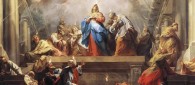
painting-tribute.jpg
The Twenty-ninth Sunday in Ordinary Time (Year A)

In the Book of Isaiah, only one person is directly referred to as the Messiah, and ironically, it’s a foreign king: King Cyrus of Persia. In today’s first reading, we hear, “Thus says the LORD to his anointed, Cyrus…” Messiah means “anointed.” When kings were installed, they would be anointed with sacred chrism (oil), and this is why Jesus would be called the Messiah: he would be the anointed king over all Israel.

Cyrus, though not Israelite (and thus a pagan), was given his authority as king over Persia by God: “I have called you by your name, giving you a title, though you knew me not” (Isaiah 45:4).

King Cyrus was given this authority in order to allow exiled Israel to return from captivity to the Holy Land to begin to rebuild the walls of Jerusalem and the Temple. Mysteriously, God directs the events of history according to his own providential plan.

St. Paul wrote in his Epistle to the Romans:

Let every person be subject to the governing authorities. For there is no authority except from God, and those that exist have been instituted by God. Therefore, he who resists the authorities resists what God has appointed, and those who resist will incur judgment … For the same reason you also pay taxes, for the authorities are ministers of God, attending to this very thing. Pay all of them their dues, taxes to whom taxes are due, revenue to whom revenue is due, respect to whom respect is due, honor to whom honor is due” (13:1-7).

But what about when the authorities decree unjust laws – laws that are against the eternal law of God such as condoning of the grave crime of abortion? Scripture provides us with the answer in Acts 5:29 when Peter, our first pope, declared: “We must obey God rather than men.” The Catechism of the Catholic Church sheds additional light on the matter:

Authority is exercised legitimately only when it seeks the common good of the group concerned and if it employs morally licit means to attain it. If rulers were to enact unjust laws or take measures contrary to the moral order, such arrangements would not be binding in conscience. In such a case, authority breaks down completely and results in shameful abuse. (#1903)

In today’s Gospel (Mt 22:15-21), Jesus says that just as we are to return to Caesar the coin that bears his image (by paying the census tax), so we are to give to God what belongs to God, bearing the divine image.

You are not your own; you were bought with a price. So glorify God in your body” (1 Cor 6:19-20). Do we daily recognize the source and goal of our lives and pay God the homage, glory, and honor he is due? By worshiping the Trinity with our whole being and living in relationship with him, through Christ, we discover the everlasting source of true joy. So let us bow before King Jesus and give him our everything, our all.

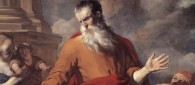
painting-disputation.jpg
The Twenty-eighth Sunday in Ordinary Time (Year A)

This Sunday’s first reading is taken from chapter 25 of Isaiah, which is a part of the Apocalypse of Isaiah.

It is said that the LORD will “destroy death” and provide an abundant feast. Also, his truth will be brought to all the nations on the earth (i.e. “the Gentiles”).

This prophecy was fulfilled when Jesus broke the power of death through his own death and resurrection and now gathers both Jew and Gentile together at the Eucharistic feast we know today as the Mass.

In the Gospel (Mt 22:1-14), Jesus gives us his third consecutive parable judgment against the unbelieving chief priests and Pharisees who served as his main audience. This one is entitled “The Parable of the Wedding Feast,” which describes Salvation History.

Those called during the time of the Old Covenant either ignored or outright refused the invitation and killed the king’s servants (i.e., the prophets). In response, the king sent his troops to destroy them and burn their city; this depicts the destruction of Jerusalem by the foreign power of Babylon beginning in 586 B.C. as judgment upon Israel’s lack of faithfulness.

Then, the king orders for the invitation to be extended to those in the main roads: that is, those non-Israelite nations (the Gentiles). This invitation began with Jesus and his ministry was extended through his Apostles’ work (read the Acts of the Apostles).

Finally, we come to the man at the feast who is without a wedding garment and is therefore cast out. This represents those who enter the kingdom, the Church, through the grace of baptism – which was depicted by a white baptismal robe in the early Church – and then commit grave sin, thus casting off the resplendent garment of grace received in Christian baptism. “Mortal sin destroys charity in the heart of man by a grave violation of God’s law; it turns man away from God, who is his end & happiness” (Catechism, #1855).

In the early Church, the newly baptized would attend Mass wearing their white baptismal robes and sit in a special section of the church set apart for them. They were then exhorted by the bishop to remain faithful to their baptism until the end of their earthly lives.

Today we also sing Psalm 23:1-6 wherein we hear the words of the psalmist: “The LORD is my shepherd… in verdant pastures he gives me repose… You spread the table before me.” On Sundays the Good Shepherd invites us to share in his rest, his repose, and to be fed at the table, the altar, of the Eucharist. He nourishes his sheep with the words of eternal life in the Liturgy of the Word and with his very own body and blood in the Liturgy of the Eucharist. At the end of our earthly life, he will lead us into the eternal banquet of heaven.

statue-st-paul.jpg
The Twenty-seventh Sunday in Ordinary Time (Year A)

The vineyard of the LORD of hosts is the house of Israel” (Is 5:7). In this verse taken from today’s first reading, the prophet Isaiah depicts Israel as a vineyard that produced bad fruit: wild grapes. This is an image of Israel’s persistent sin, iniquity, wickedness, vice.

Building upon this imagery of Isaiah, Jesus presents us with the Parable of the Wicked Tenants in today’s Gospel (Mt 21:33-43), which follows the Parable of the Two Sons – the Gospel reading from last Sunday.

Jesus, in the tradition of the prophets, is speaking in parables. In the Old Testament, prophets would turn to parables when the audience hardened their hearts.

In today’s Gospel, the vineyard is Jerusalem. The hedge around it is the city walls. The tower is the Jerusalem Temple. The tenants are the leaders of Israel. The beaten and killed servants are the Old Testament prophets. The son, who was thrown out of the vineyard and killed, is Jesus, God’s Son who was crucified outside the walls of Jerusalem on Calvary.

Today’s parable is a prophetic judgment against the leaders of Israel: “When the chief priests and the Pharisees heard his parables, they knew that he was speaking about them. And although they were attempting to arrest him, they feared the crowds, for they regarded him as a prophet” (vs. 45-46).

The final line of today’s Gospel goes like this: “the kingdom of God will be taken away from you and given to a people that will produce its fruit” (v. 43).

If we, the vineyard of the LORD, the Catholic Church, are the people spoken of in today’s Gospel, then we should be asking ourselves if we produce the fruit our LORD speaks of: “Unless your righteousness exceeds that of the scribes and Pharisees, you will never enter the kingdom of heaven” (Mt 5:20).

In the second reading, St. Paul exhorts his audience in the Letter to the Philippians to “keep on doing what you have learned and received and heard and seen in me” (Phil. 4:9). In other words, we are to emulate the life of Saint Paul as a model of how to live and to live out the instruction handed on through him to us.

This is the reason the Church canonizes saints: to give us authentic role models by which we are to act by the gift of the new life received in baptism then restored or renewed in the other sacraments.

The saints are precisely those to whom the kingdom has been given. Filled with the life of the Spirit, they were remade in the likeness of Christ made the will of the Father their daily bread. Likewise, we who were made holy at our baptism are each called to this same holiness, which will culminate with the joy of heaven.

icon-christ55.jpg
The Twenty-sixth Sunday in Ordinary Time (Year A)

The name Ezekiel means “may God strengthen me.” Today’s first reading is from the prophet Ezekiel, who describes two different Israelites. The first is virtuous and turns from virtue to iniquity. Thus, he dies due to his iniquity (i.e. “sin”; iniquity literally means “uneven”).

The second Israelite is wicked, yet he turns away from his wickedness, his iniquity. Thereafter, this man preserves his life: “he shall not die” (Ezekiel 18:28).

In today’s Gospel, St. Matthew describes the chief priests and elders (representatives of the Sanhedrin) who approach Jesus to question him. Jesus presents them with the Parable of the Two Sons. The father of the two sons asks them separately to go out and to work in the vineyard.

The first son replied to the father’s command negatively before changing his mind and doing the father’s will (see Mt 7:21). This son corresponds with the second man Ezekiel described in the first reading: he turns from his wickedness.

The second son pays mere lip service to his father, responding initially in the positive, but in the end, he fails to carry out the will of his father (again, see Mt 7:21). This son images the first man Ezekiel spoke of: he begins virtuous – giving a verbal “yes” – but in the end, he lies in the filthy muck of his own iniquity.

Both Jesus’ questioners and the public sinners of Jesus’ ministry stand within the depths of their own different types of iniquity. In Jesus’ day, it was the prostitutes and tax collectors (remember, St. Matthew was a tax collector) who humbly recognized their sin and allowed Jesus to heal them.

When we compare the first reading and the Gospel with the second reading taken from St. Paul’s Epistle to the Philippians, we come full circle. The Apostle exhorts Christians to follow Jesus who humbled himself, “taking the form of a slave” (Phil 2:7). The lesson for us to learn is that humility serves as the ground principle of Christianity.

In prayer, let us bow before our Heavenly Father and ask him to strengthen us to both assent to and walk in his divine will. This takes the humility of one who imitates Jesus who “humbled himself” (Phil 2:8). The art of imitating Christ can only be accomplished by a life of prayer in union with the same Christ.

Unless humility precede, accompany, and follow every good action which we perform, being at once the object which we keep before our eyes, the support to which we cling, and the monitor by which we are restrained, pride wrests wholly from our hand any good work on which we are congratulating ourselves” (St. Augustine, Letter to Dioscorus [Letter 118], par. 22).

icon-jesus-vine.jpg
The Twenty-fifth Sunday in Ordinary Time (Year A)

In today’s Gospel reading from Matthew 20:1-16, Jesus pulls from the rich literary background of the Old Testament in order to teach us eternal truths about his salvific work and the Church he is establishing.

In Psalm 80, Israel is depicted as the vine that was brought out of Egypt and planted in the Promised Land. The prophet Isaiah wrote, “The vineyard of the LORD of hosts is the house of Israel” (Is 5:7). Hosea the prophet describes Israel like this: “Israel is a luxuriant vine whose fruit matches its growth” (Hos 10:1).

Throughout Salvation History, God has worked to form a family united to him through the covenant, and through successive stages, this family grew in time from a single married couple consisting of Adam & Eve to the vast kingdom of Israel ruling over other nations.

In the final, new, and everlasting covenant, the culmination of Salvation History is found in the last, final, and greatest King of Israel: Jesus the Christ. This king, who is eternally begotten by God the Father, intends to increase the family of God from a national kingdom to an international kingdom. Thus, God’s family will now include – on an equal measure – all peoples, including the Gentiles: the nations other than Israel. God’s family will be universal, or, catholic.

With the advent of Jesus, God’s vineyard (i.e., Israel) is increasing both in size and shape by its very ethnic makeup. In this parable told by Jesus, the laborers hired in the cool of evening are the Gentile converts who join the family of God late in the game.

This continuity of the family of God from the Old Testament into the New Testament explains why Saint Paul feels such freedom to call the Catholic Church in the very end of the Epistle to the Galatians “the Israel of God” (Gal 6:16). It also sheds light on how in the Epistle to the Romans, Paul describes the unbelieving Jews as “branches [who] were broken off” of the olive tree and the believing Gentiles as “a wild olive shoot [who] were grafted in their place and have come to share in the rich root of the olive tree” (Rom 11:17).

It is important to understand that God does not have two families: the Jewish people today and then, on the other hand, the Catholic Church. Rather, the Catholic Church is the very continuation of the family of God and has for her head, the King of Israel: Jesus. She first consisted of faithful, believing Jews: Mary, Jesus, Joseph, the 12 Apostles, and all the rest. All peoples – whether Jew, Hindu, Buddhist or Muslim – are called to salvation through Jesus Christ in his one, holy, Catholic, and apostolic Church: God’s covenant family. Jesus wishes to bestow his grace and life upon every single human person, regardless of their nationality.

picture-cross.jpg
The Feast of the Exaltation of the Holy Cross (Year A)

Every year, we celebrate the Feast of the Exaltation of the Holy Cross on September 14th. This ancient feast of the Church celebrates the victory of Jesus won upon the wood of the Cross nearly 2,000 years ago.

The first reading from Numbers 21:4-9 is a foretype of the Cross. This means that we see an image of the Cross, like a shadow is an image of the object it is cast from as the sun hits that object. In today’s Gospel from John 3:13-17, Jesus refers us back to this Old Testament passage wherein Moses constructed a bronze serpent and mounted it on a pole so that the Israelites who had been bitten by deadly saraph serpents would live when they gazed upon this peculiar graven image. Jesus said:

And just as Moses lifted up the serpent in the desert, so must the Son of Man be lifted up, so that everyone who believes in him may have eternal life.

The saraph serpents were the result of the Israelites’ sin, and they were healed by gazing upon the image Moses constructed at God’s command. Likewise, we are wounded from our sin, in grave need of a Savior. By faith in Jesus Christ and his redeeming work upon the cross, we are healed and elevated by grace.

In the second reading, St. Paul speaks of that cross:

He emptied himself, taking the form of a slave, coming in human likeness; and found human in appearance, he humbled himself, becoming obedient to death, even death on a cross. (Philippians 2:7-8)

Lest we forget, the cross was a Roman instrument of a torturous death – something to be greatly feared. The very thought of the Immortal and Almighty God coming among us as one of us to suffer it is nearly unthinkable. The Cross contains the greatest message the world has ever been communicated: God is an intense lover who loves us individually beyond our wildest dreams.

For this reason, the crucifix has become an integral part of Catholic worship and life. It reminds us of the intensity of the divine love for each of us personally. It also reminds us of the way to love like God.

The Catechism of the Catholic Church tells us:

The way of perfection passes by way of the Cross. There is no holiness without renunciation and spiritual battle. (#2015)

Jesus paved the way as our divine role model. He taught us how to live as sacrificial selfless lovers by the way of the Cross. Baptized into him, we attain to the likeness of Christ insofar as we renounce the love of self and imitate his self-giving nature. We are given the ability to do this through each of the 7 sacraments, for we cannot love like Christ on our own apart from the grace, the divine help, of God himself.

icon-jesus-teacher.jpg
The Twenty-third Sunday in Ordinary Time (Year A)

The authors of the Gospels frequently used a particular literary device called allusion. Allusion is when a writer implicitly refers to something well known to his audience, thus allowing his readers to catch the hidden, implicit meaning of the words.

Throughout his Gospel, St. Matthew uses literary allusion to convey Gospel truth. In today’s Gospel reading, Matthew records Jesus giving advice to those dealing with an unrepentant sinner.

If your brother sins [against you], go and tell him his fault between you and him alone. If he listens to you, you have won over your brother. If he does not listen, take one or two others along with you, so that every fact may be established on the testimony of two or three witnesses” (Matthew 18:15-16).

When interpreting the Bible, the Catechism urges us to “be especially attentive to the content and unity of the whole Scripture” (CCC 112).

In Mt. 18:15-16, Jesus alludes to the Torah or Law of Israel, specifically in Deuteronomy 19:15, which says: “One witness alone shall not take the stand against a man in regard to any crime or any offense of which he may be guilty; a judicial fact shall be established only on the testimony of two or three witnesses.

Then, Jesus says to his twelve disciples: “Amen, I say to you, whatever you bind on earth shall be bound in heaven, and whatever you loose on earth shall be loosed in heaven.” Again, Jesus alludes to Isaiah 22:22 (this was last Sunday’s first reading). This language signifies the conference of authority to make binding, juridical decisions in kingdom administration.

It is within the context of this that we hear the often heard Bible passage: “If two of you agree on earth about anything for which they are to pray, it shall be granted to them by my heavenly Father. For where two or three are gathered together in my name, there am I in the midst of them” (Matthew 18:19-20).

Is Jesus speaking about his omnipresence among just any two believers that gather together? This is a very popular interpretation. However, if this is what Jesus means, then he has just taken a very wide tangent from the topic at hand. It does not fit the context.

Much more likely is that Jesus is speaking about his personal affirmation of his appointed disciples’ decision to exclude Christians from her bosom should they remain recalcitrant (i.e., unrepentant). This passage is affirming the that the apostles (and their successors in office) have the real authority – derived from Jesus himself – to confer the penalty of excommunication upon those who refuse to repent. Jesus is present authoritatively through those he has ordained.

picture-liturgy.jpg
The Twenty-second Sunday in Ordinary Time (Year A)

Every day of the week, the Mass presents us with several readings from the Bible that correspond with one another, including the responsorial psalm.

Taken together, if you look carefully, you can discern the golden thread that ties each reading together. This overarching theme is what Christ wishes for us to meditate upon and therefore allow both it and the grace received in the Holy Eucharist to change us.

In the end, we are to be converted. This means that the way we think, how we act, what we say, even the very reasons for which we live become identical with Jesus. That is, we are to be continually transformed into the very image and likeness of the eternal Son of God, whose life we have received in the waters of Baptism. Our ultimate destiny and our ultimate happiness lies in Christ and his life.

With this in mind, what could be more practical, more reasonable, and more necessary than a fruitful, active participation in the Liturgy? This is the real meal deal. At each Mass, if we tend our minds and pray with our hearts, serious fruit can be borne that will have lasting effects outside of the Sunday liturgy.

Last week’s theme was the papacy. That is, we learned just where in Scripture we find the Biblical foundations for why we have a “pope.” The first reading from Isaiah 22 corresponded with the Gospel passage taken from Matthew 16.

This week, in his inspired and living word, Jesus asks for us to discern whether or not our Christian life has become a burning sacrifice as that of the Prophet Jeremiah in the first reading. As he prophesied the destruction of Jerusalem due to Israel’s continuing idolatry, Jeremiah expresses that his mission brought him derision. He felt as if he were a living sacrifice. To Jeremiah, God’s truth is “like fire burning in my heart, imprisoned in my bones.” He had to share it publicly, even to his own ridicule! (Jer. 20:9)

The psalmist expresses his awesome longing for the Lord, as if his soul were a parched land without water. To him, God’s love “is better than life” (Ps. 63: 4).

Saint Paul - who lived his message as a living, breathing martyr for the love of Jesus - urges us to offer our bodies as a living sacrifice. This is impossible without the self-abandonment of heartfelt prayer, the prayer of a Christian in love with Jesus, who discerns that God’s eternal love is better than natural life.

In the end, all of this is a participation in the self-offering of Jesus, expressed in today’s Gospel: “Whoever wishes to come after me must deny himself, take up his cross, and follow me” (Matthew 16:24).

painting-keys.jpg
The Twenty-first Sunday in Ordinary Time (Year A)

This Sunday’s Gospel is taken from Matthew 16:13-20, where Jesus did something that is central to a proper understanding of the Church he established. In his Gospel, Matthew presents Jesus as a King. He begins with: “The book of the genealogy of Jesus Christ, the son of David.” For 6 centuries, Israel had been waiting for King David’s descendant to reign as the Christ. Christ means The Anointed One - because it was through an anointing that one became the king of Israel (cf. 1 Sam 16:13 when David was anointed).

Matthew is saying, “Wake up guys! Our king has come and he has established his kingdom!” By alluding to the Old Testament throughout his Gospel, Matthew is showing us the shape of the kingdom on earth. Early Christian Scriptural commentary nearly always equated “the kingdom” with the Catholic Church.

In ancient dynastic kingdoms, kings would establish a vizier {viz-EER} to take care of affairs with the full and supreme authority of the king. This royal office is much like the office of prime minister in the kingdoms of Europe.

There are two Old Testament examples of this that will help us decipher today’s Gospel account. First, in Genesis 41:1-46, Joseph was made Pharaoh’s vizier after God revealed to Joseph the meaning of Pharaoh’s dream. In fact, Pharaoh said to Joseph, “Only in respect to the throne shall I outrank you!

Second, in Daniel 2:1-49, Daniel was made King Nebuchadnezzar’s chief prefect after Daniel interpreted the king’s dream. Nebuchadnezzar said to Daniel, “Truly your God is the God of gods and Lord of kings and a revealer of mysteries; that is why you were able to reveal this mystery!

Now we come to today’s Gospel narrative. Jesus first tells Peter that God has revealed Jesus’ true identity to Peter. This is reminiscent to Joseph and Daniel, both of whom received a special revelation from God just before they were appointed to the highest ranking office in the kingdom. Then, like Joseph and Daniel, Peter is elevated by the King to the royal kingdom position of vizier as Jesus says, “I will give you the keys of the kingdom” (Mt. 16:19).

The “keys of the kingdom” are symbols of kingdom authority, as we see in the first reading when Eliakim replaced the corrupt official, Shebna, in the office of vizier to the Davidic King. Jesus deliberately uses language that mirrors this Old Testament passage (Is. 22:15-23) to loudly proclaim that he is indeed establishing what we call the Petrine Office. Just as Shebna held an office, to which he was succeeded by Eliakim, so Peter is succeeded by his successors: the popes of the Church, the restored Kingdom of David.


Subscribe to the Podcast featuring Understanding the Scriptures:

or

Recommended Books:
(View Our Entire Bookstore)
 
 
Recommended free software
to optimize your computer:


Catholic Gifts at The Catholic Company


So you want a website like this.. we understand.
Why don't you use the web hosting & design services of Boerne.com, like we do?

This site is powered by WordPress v 2.0.6, PodPress v 7.0, and the Holy Spirit